The Invention of HVAC

This is one of those topics that most people don’t think nearly enough about. However, if you were to research it, you would find out that heating and cooling systems have been in place for centuries. Ancient cave dwellers dug holes in the ground to take advantage of geothermal cooling and Egyptians hung wet reeds in the windows to enhance the coolness of the breeze.
Of course, there were multiple ways that people heated their homes--fire has almost always been the favored heat source. Greeks even used it to create an early version of radiant floor heating! We would like to take a deeper look at modern heating--who invented it, and other pertinent pieces of information. Keep reading for more information!
Who Invented The Modern HVAC System?
 The man credited with inventing the modern HVAC was a man by the name of Willis Carrier.
He was actually attempting to solve the problem of humidity in a publishing house in New York.
This situation led him to inadvertently create the first model of a heating and cooling system!
What a Modern Air Conditioner Looks Like
Modern air conditioners generally operate in the same manner with similar components. Typically, there is an indoor part and an outdoor part that work together to create cold air distributed via ductwork. Here is a deeper look at how these components work:
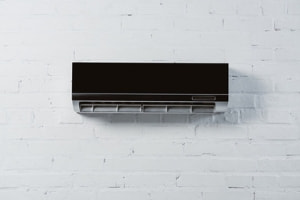 Air Handlers- this isn’t the first part you think of when you think about an AC. However, it has a major role. Typically, these are located in a closet, the attic, or even a basement.
These boxy-looking units consist of a few parts, but most importantly, the evaporator coils and the blower. The coils have liquid refrigerant that absorbs heat from the air.
The air is cooled and is blown into the ducts to be distributed through the house. As the refrigerant absorbs heat, it expands into a gas and is sent to the condenser via a conduit.- Condensers- this part of the unit primarily condenses the refrigerant back to a liquid so it can be reused. When the gas turns back to liquid, heat is released and a fan blows it away from the unit.
The Lifespan of an HVAC System
 Knowing how long an HVAC will last is important and knowing where your unit stands in relation to that number can help prevent a cooling emergency! An HVAC system typically last 10-15 years, but this is an average.
Just because a unit is 8 years old, it does not necessarily mean that it has another 2 years left and similarly, a unit that is 14 years old does not have to give out in the coming months.
If you bought your current HVAC, you probably know the age of it. If you bought your house without asking that question, finding the answer isn’t difficult. All you will need to do is look at the serial number.
There should be a series of digits printed and this will tell you the year and week of the year the unit was manufactured. For example, if you see the number 1222, it is unlikely that the unit was built in 1912, 1922, or 2022. So, 2012 was the year and 22 stands for the week number.
Call Skovron Mechanical Services LLC. For HVAC Help, Installs, And Information!
Skovron Mechanical Services LLC. enjoys being the company that is called with questions--we’re here to answer them. Whether you’re unsure if you should replace your heater or if you can't decipher how old the unit is, we can help! Call us today with all of your HVAC problems or to consider installing a new heater!